




The LTC Conversation You Can’t Keep Avoiding

There’s a moment every advisor knows too well.

You’re building the plan, reviewing the assets, talking income strategies…
and then you hit the section everyone tiptoes around:

Long-term care.

Clients get uncomfortable.
You get cautious.
And the conversation drifts to “We’ll look at this next time.”

Except next time rarely happens.
And when the need shows up later? It’s already too late — and the fallout lands on the advisor anyway.

Here’s the truth advisors don’t talk about enough:

Avoiding LTC planning is a risk multiplier — for the client and for the advisor.

The financial strain, the emotional pressure, the family dynamics, the market timing…
LTC doesn’t wait for a convenient moment to show up.
And when it does, it exposes every gap in the plan.

The real dilemma isn’t whether clients need a plan.
It’s whether the advisor is the one who finally leads the conversation.

Because someone will.

And it should be you.

Why Advisors Put Off the LTC Discussion (And Why It’s Costly)

Let’s be honest:

Most advisors aren’t avoiding LTC because they don’t care.
They’re avoiding it because:

  • The options feel complicated
  • Traditional LTC has baggage
  • Clients shut down when they hear the words
  • The “what-ifs” are emotionally heavy
  • The industry hasn’t made the conversation easy

But here’s what advisors are learning fast:

Silence isn’t neutral. It erodes trust.

Clients look to you for clarity — especially in the messy parts of financial planning.
If you don’t bring up LTC early, decisively, and with confidence, you risk:

  • A plan that’s incomplete
  • Assets forced into liquidation
  • Surviving spouses thrown into panic
  • Family members resenting the lack of guidance
  • Your value as “the advisor who sees around corners” taking a hit

The best advisors today aren’t avoiding the conversation.
They’re leading it — and winning deeper loyalty because of it.

3 Triggers That Can Start Conversations

Most LTC conversations die because they start in the wrong place: product first.

Better approach: start with what’s most likely to change first.

Every LTC scenario begins with one of three triggers:

  • Mind: cognitive decline, memory lapses, early judgment issues
  • Body: mobility limitations, injury recovery, chronic conditions, surgery rehab
  • Support System: spouse health shifts, kids living out of state, no nearby family, “solo agers”

Why this matters: once you identify the first trigger, the rest gets clearer fast—what type of care is most likely, how long it could last, and what kind of planning structure makes sense.

This isn’t about scaring clients.

It’s about giving them a simple, human framework that turns LTC from “awkward topic” into “practical planning.”

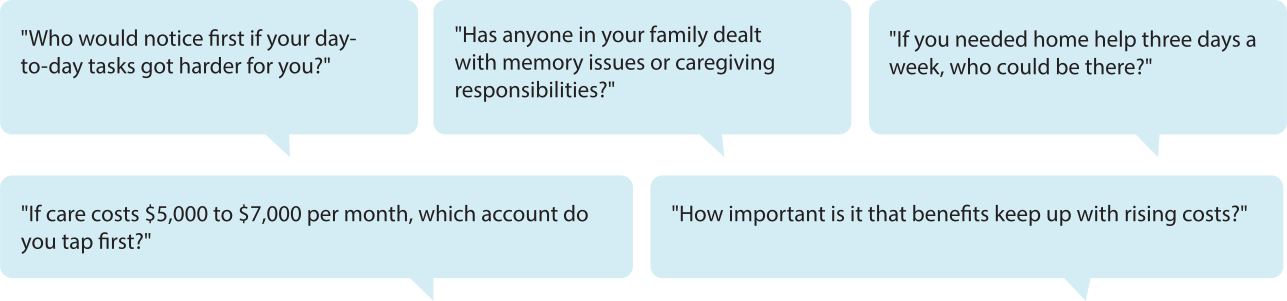
LTC ICEBREAKERS

Start every LTC discovery conversation with human-first questions that feel natural, not scripted. These openers create safety and invite clients to share what matters most to them.

The New Reality: LTC Solutions Have Evolved

This is the part most clients and advisors don’t know:

LTC conversations don’t have to feel like the old days.

You’re no longer stuck between:

traditional LTC with uncertain premiums
or no coverage at all

Modern products — annuities with enhanced benefits, life with riders, hybrid approaches, asset-based strategies — give advisors flexibility that didn’t exist a decade ago.

The conversation can now sound like this:

“We’re not here to scare you.
We’re here to build a plan that protects your income, your family, and your independence — no matter what life throws your way.”

That’s a conversation rooted in confidence, not fear.

When “We’ll Just Pay for It” Isn’t a Plan

You’ll hear it all the time:

“We have the assets. We’ll just self-insure.”

Here’s the truth: self-insuring is not a long-term care plan.
It’s a payment method — usually the most expensive one.

Because self-funding is dollar-for-dollar. And LTC doesn’t ask permission before it shows up. It hits when the market is down, when liquidity is tight, when a spouse is vulnerable, and when decisions are being made under stress.

Planning isn’t about whether your client can pay.
It’s whether they should.

The best advisors don’t argue with self-funding. They reframe it:

  • What happens to the plan if care costs $6,000–$10,000 a month for two years?
  • Which bucket gets drained first?
  • And what does that do to income, taxes, and the surviving spouse?

Clients who built wealth understand leverage. LTC planning is the same principle: don’t pay retail if you can structure it smarter.

The Advisors Who Win LTC Discussions Use a Simple Rule: Lead Early. Lead Clearly.

Clients don’t expect you to predict the future.
They expect you to prepare them for it.

The advisors who get this right:

  • Bring LTC up every time
  • Keep the conversation simple, human, and strategic
  • Use modern tools instead of outdated assumptions
  • Position LTC as protection, not pessimism
  • Show how a plan supports income, family, and longevity
  • Use clarity to reduce fear

Because when you lead with confidence, clients follow.

Bring Us the Messy Ones. We’ll Help You Design the Case.

If this topic keeps getting pushed to “next meeting,” here’s your fix:

Schedule a 15-minute LTC Case Huddle with the DMI LTC Desk.

Keith Schettino
VP Life Sales

Joshua Rhem
VP Life Sales

Bring a real client scenario — even the one you think is too complicated:

  • underwriting concerns
  • unclear funding sources
  • spouses with different goals
  • “we’ll just self-insure” resistance
  • old annuities/CDs that aren’t pulling their weight

We’ll help you turn client language into a clear plan—benefit structure, inflation choices, funding path, and a rationale you can confidently walk back to the client.

Stop avoiding the conversation. Start leading it.
And when you’re ready, we’ll build it with you.

JOSHUA RHEM
VICE PRESIDENT – LIFE SALES

Joshua Rhem has over 15 years of experience in Insurance and Investment services, with experience as an RIA to financial institutions, an insurance producer, and wholesaler. Throughout his career Joshua has always been especially interested in making sure that insurance is viewed as a vital component of a well-constructed comprehensive financial plan. Understanding the obstacles that advisors face each day, Josh is eager to support them, and promptly responds to their needs. He enjoys helping advisors, brokers and agents grow their business with strategies to identify opportunities and helping to effectively position insurance products as meaningful solutions to their clients’ financial goals.

Or Call 781-919-2325