
By Erick Lindewall, Vice President of Annuity Sales, DMI
A few weeks ago I was on a call with an advisor who’s been writing FIA business almost as long as I have. Smart guy. Big book. He was bracing for the renewal conversation.
You know the one.
A client he wrote in 2020 was about to hit renewal. The initial S&P 500® participation rate had been 50%. The new rate? 27%.
The phone call was coming. He didn’t have a great answer.
I told him there was one — and that it would do three things he couldn’t do a quarter ago:
One. It would let him walk into the renewal call instead of waiting for it to find him. Not with an apology — with an upgrade.
Two. It would reframe the conversation from “your old rate dropped” to “your old rate is the reason we need to look at what just launched.” That’s a cross-sell, not a damage-control call.
Three. It would give him a participation rate to talk about — 97% to 112% — that, if he didn’t bring it up first, his competitor was going to bring up in the next review meeting.
That’s the call he wanted to be on. Not the one he was dreading.
Here’s what changed.
Same Road. Same Destination. Different Ride.
For the last 20 years, the standard S&P 500 FIA has been a car without shocks. The road is the market. The destination is the client’s retirement. The car gets there. It always gets there.
But every passenger in the back seat is going to feel it.
Initial participation rates that looked great. Renewal rates that punched the client in the gut. A “rate rollercoaster” that quietly cost advisors retention — even when the underlying performance was fine. The vehicle made it down the road. The ride was punishing.
In September, S&P Dow Jones Indices launched a new index called the S&P 500® Distance Stabilizer. Built in collaboration with Société Générale. Engineered around a “distance timer” mechanism rooted in academic research from the mid-1990s.
It’s an exclusive Annexus index, which means it’s only available through carriers that partner with Annexus on the structure. DMI has access to those products — across multiple carriers and product chassis — so the conversation isn’t limited to one shelf.
And here’s what it really is: shocks.
Same road. Same destination. The vehicle finally rides like something built in this century.
The Old Pitch Becomes Someone Else’s Problem
Let me explain the mechanics — because the mechanics are what make this matter, not the marketing.
A standard S&P 500 FIA participation rate gets repriced every renewal based on the cost of the options the carrier uses to hedge their exposure. When market volatility spikes, options get more expensive. When interest rates move, options get more expensive. When either gets bad enough for long enough, the carrier’s hedging budget can’t support the same participation rate as before.
So the rate drops.
That’s not anyone’s fault. It’s the structure.
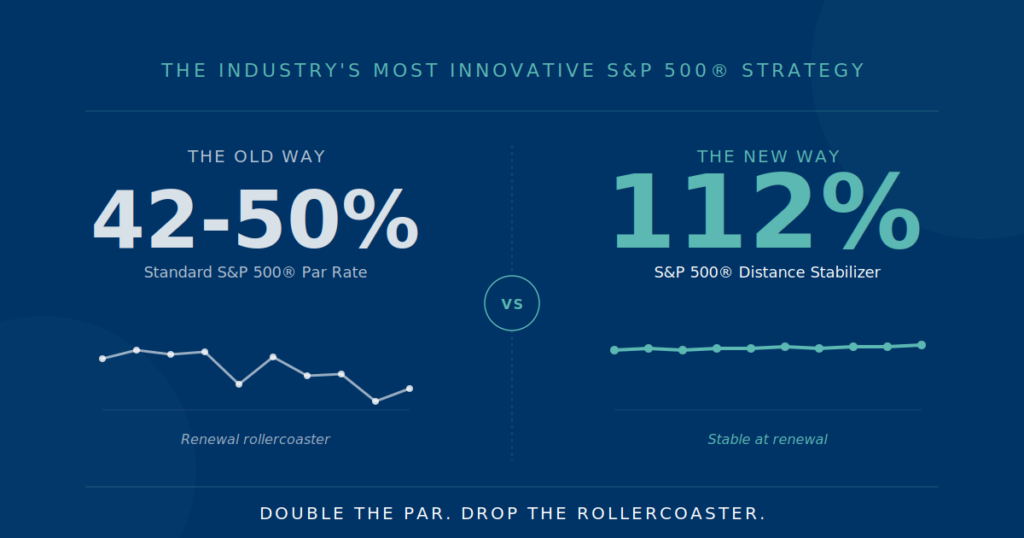
The standard uncapped S&P 500 FIA in the market right now is paying 42–50% participation. That’s the ceiling, even in a relatively calm environment. Two-year strategies sit at 43–60%.
The S&P 500 Distance Stabilizer changes the math because it changes the volatility profile inside the index. It uses seven successive distance timers that monitor the market daily and adjust S&P 500 exposure dynamically — de-risking during prolonged volatile periods, re-engaging during recoveries. The average S&P 500 exposure over the back-test runs about 90%.
Translation: it tracks the benchmark your clients already know and trust. It just rides smoother.
For the carrier, that smoother ride means more efficient hedging. More efficient hedging means a budget that can sustain higher participation rates — and renew them with less variability.
Current participation rates on the Distance Stabilizer are running 97% to 112% — depending on the product and term.
That’s not a teaser rate. That’s not a typo. That’s a structural improvement in the underlying engineering of how an FIA tracks the S&P 500.
What This Means for Your Book Right Now
Three places this hits in the next 90 days.
The renewal conversations you’ve been dreading. If you wrote S&P 500 FIA contracts five years ago at 50% participation that are now renewing at 27% or 36%, you’re about to be in some hard meetings. The honest answer isn’t “hope it recovers.” It’s “let me show you what we have now.” That’s a different conversation entirely — and it’s a cross-sell.
The new business pipeline. Your competitor is about to walk into your client’s review meeting with a participation rate more than double what the standard S&P 500 FIA can offer. If you’ve never heard of the Distance Stabilizer when that meeting happens, you’re playing defense for a quarter. Maybe two. Get ahead of it.
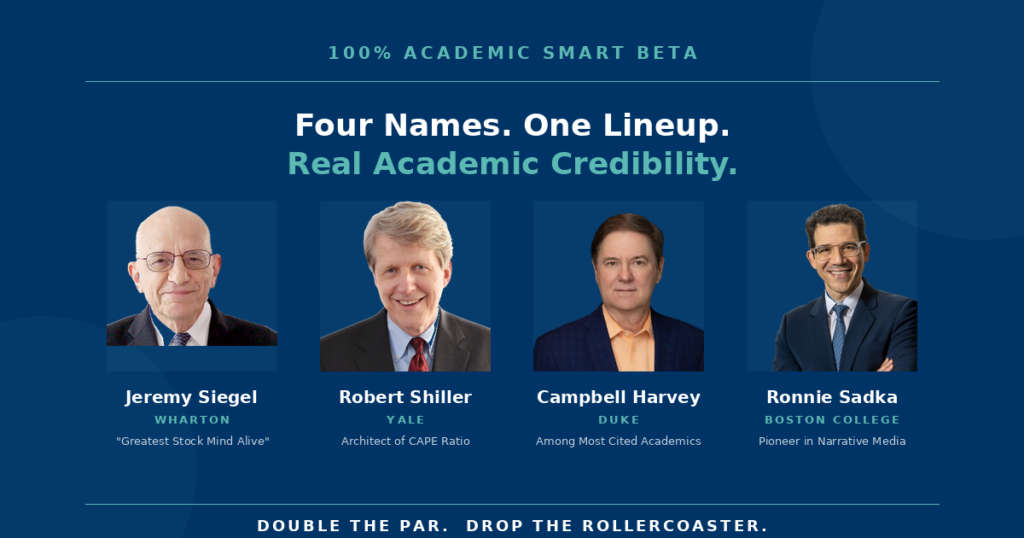
The bigger portfolio story. The Distance Stabilizer is the headline, but the full portfolio lineup behind it also includes academic smart beta indices built on research from Robert Shiller (Yale), Jeremy Siegel (Wharton), Campbell Harvey (Duke), and Ronnie Sadka (Boston College). Names your clients have actually heard of. Credibility you can lean on in a review meeting. The Distance Stabilizer opens the door — the academic lineup keeps the conversation going.
The Honest Caveats
I’ve been around this industry long enough to be skeptical of any product that sounds too good. Let me say what this isn’t.
It isn’t a guaranteed rate forever. The 112% participation is the current rate at launch — like any FIA, future renewals are subject to repricing. The structure is designed to make those renewals more stable, but “more stable” doesn’t mean “fixed.”
It also isn’t a free lunch. The Distance Stabilizer may underperform the S&P 500 in prolonged volatile or high-interest-rate environments. That’s the trade-off when you build a stability mechanism into the index — you give up some upside in the wildest periods to avoid the worst of the downside.
And it doesn’t replace the S&P 500 for clients who want pure benchmark exposure. It tracks the S&P 500 closely — averaging ~90% exposure across the back-test — but it isn’t the same thing.
What it is, is a structural improvement to a product category that hadn’t seen one in years. That’s the headline. Everything else is honest disclosure.
What to Do With This
On May 20 at noon ET, Tom Haines — EVP of Capital Markets and Index Solutions at Annexus, and the person who actually owns the index review and implementation process behind this lineup — is sitting down with me on a DMI University webinar.
We’ll walk through how the Distance Stabilizer actually works. The mechanics behind the 97–112% participation rates. How the academic smart beta lineup changes the credibility math in client reviews. And the practical positioning to bring this into your next meeting.
Sixty minutes. Open to agents, advisors, and RIAs.
Tom doesn’t do many of these. When he does, the people in the room walk out understanding something their competitors don’t.
If you’re going to be in those renewal conversations this year — and you are — you want to be one of the people who knows what’s underneath the vehicle now.
🗓 Wednesday, May 20 | 🕛 Noon ET | 💻 Live 60-minute session
See you Wednesday.
Erick Lindewall is Vice President of Annuity Sales at DMI. He has spent more than 35 years in the financial services industry, working with agents, advisors, and RIAs to engineer better outcomes for the clients sitting across their desks.
Or Call 781-919-2351
