
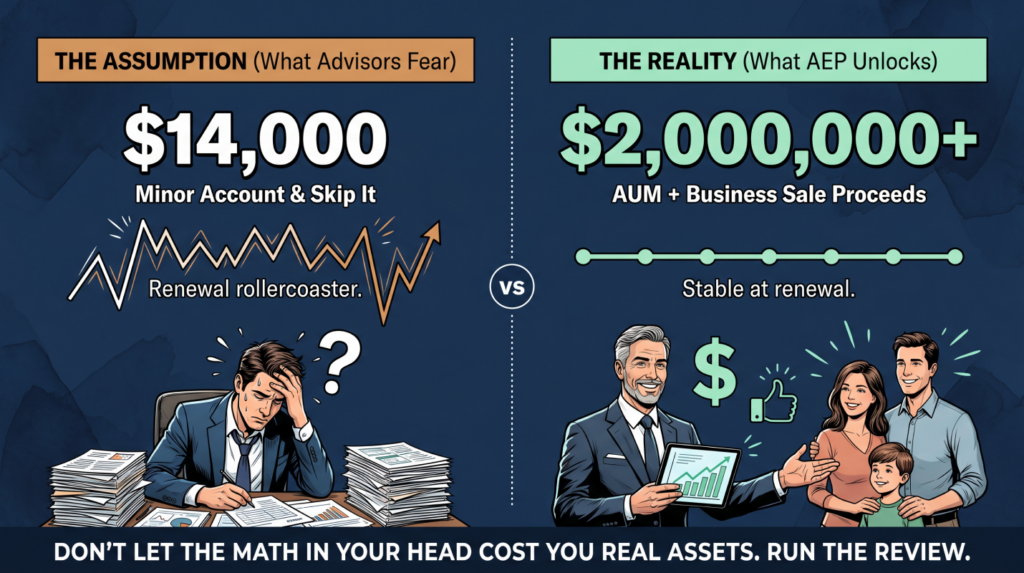
A DIY couple. A $14,000 college account. One review the advisor almost skipped because he assumed it would take too long. Here’s what 14 minutes actually unlocked — and why the math most advisors do in their head is costing them real money.
The couple sat across from their advisor and said the sentence that ends most planning conversations before they begin:
“We already have an estate plan. We probably just need an update.”
He managed a $14,000 529 for their daughter. That was the entire relationship. They ran their own investments. They’d had a trust drawn up years ago. They were, by their own account, fine.
He almost let it go.
He didn’t. He ran the review.
Fourteen minutes later, he had a list that would change the trajectory of the entire relationship — and put him on track to manage $2 million in assets.
The mistake isn’t expertise. It’s the math you do in your head.
When a client says “we’ve got it handled,” most advisors hear “don’t push,” skip the review, and move on.
That instinct isn’t laziness. It’s a math problem.
Every advisor runs a silent calculation when estate planning comes up: How long is this going to take? How much do I need to know? How much friction will it add to a relationship that’s already working?
Most of the time, the answer they land on is: too much for the upside.
That answer is wrong — and it’s costing real assets.
A real estate planning review, run with the right partner, doesn’t take hours. It takes about 14 minutes — most of which is your client talking. You don’t read the documents. You don’t analyze the trust. You don’t issue tax opinions. You send the documents to a partner who does this every day, and you get a structured report back.
What advisors are really avoiding isn’t the work. It’s a story they’ve told themselves about the work.
What 14 minutes uncovered
This advisor brought in AEP — his estate planning partner — for a no-cost document review. Standard process. Here’s what showed up:
Only the husband had a complete plan. The wife had no power of attorney. No healthcare directive. Nothing. If she’d been in an accident that afternoon, the family would have been in court.
The trust wasn’t funded. Real estate in multiple states sat outside of it. They were unknowingly setting up their daughter for multiple probate proceedings in multiple jurisdictions.
No guardians were named for their minor child. They’d been “meaning to do it” for three years.
The pending business sale was a tax bomb. The proposed structure heavily favored the buyer. Payments were categorized in ways that would have dumped tens of thousands in unnecessary annual taxes onto the seller — when the same dollars, restructured as equipment, lease, and other components, would have been taxed dramatically differently.
None of this was visible from the outside.
All of it was visible in 14 minutes.
The turning point — and it wasn’t the taxes
Here’s where most case studies bury the real lesson.
The clients didn’t care about the trust funding mistakes. They didn’t even care that much about the tax restructure — though they took the win.
They cared about their daughter.
When AEP and the advisor brought the named guardians — the actual people who would raise this child if something happened — into the conversation, the entire dynamic shifted. The guardians started asking the advisor questions:
“How will the money be managed?”
“What happens if the worst case happens?”
“Who do we call?”
The advisor wasn’t selling anything. He was just the only adult in the room with answers.
That’s the moment a financial relationship stops being transactional. That’s the moment you stop being the 529 guy.
What a $14,000 relationship turned into
- The previously self-managed brokerage account: transferred over.
- The $2M+ business sale proceeds: positioned for management when the deal closes.
- The tax structure: rebuilt with the advisor’s tax pro. Tens of thousands in annual savings.
- Two new qualified prospect intros: the successor trustee and the guardians. Both with their own assets. Both now asking who their advisor is.
A $14,000 relationship is on track to clear $2 million in AUM — plus a tax win, plus a multigenerational relationship, plus two warm leads.
All of it traceable to 14 minutes the advisor almost didn’t spend.
A note on what 14 minutes actually is
Fourteen minutes is the find time. Not the fix time.
The fix takes longer — that’s where AEP does the work: drafting documents, coordinating with the tax professional, restructuring the trust, walking the guardians through their role. Some of that takes weeks.
But 14 minutes is all it takes to find out whether any of that work is sitting in front of you, invisible.
That’s the math advisors get wrong. They’re declining to spend 14 minutes because they’re imagining the 14 weeks.
The 14 minutes is yours. The 14 weeks is ours.
Three lines worth saving
- The review takes 14 minutes. Skipping it costs years. Every “we have a plan” is either a hidden opportunity or a hidden liability. Both are good news for the advisor who actually looks.
- You don’t need to be the estate planning expert. You need the right partner. Most advisors avoid this conversation because they think they have to lead it technically. Wrong job. Your job is to ask the question and bring the specialist. AEP does the rest.
- Clients won’t remember the tax savings. They’ll remember the guardian conversation. Tax math is forgettable. The moment somebody finally helped them figure out what happens to their kid is not.
This case isn’t unusual. It’s the pattern.
We’re walking through three more on a live session with the AEP team — including one where the advisor did walk away, and exactly what it cost him.
You’ll leave with:
- The four-question intake script that surfaces opportunities like this in any client review
- The AEP partner workflow — what we do, what you do, what the client sees
- The one-page document checklist you can hand a client this week
🗓 Wednesday, June 24 | 🕛 Noon ET | 💻 Live 60-minute session
Erick Lindewall is Vice President of Annuity Sales at DMI. He has spent more than 35 years in the financial services industry, working with agents, advisors, and RIAs to engineer better outcomes for the clients sitting across their desks.
Or Call 781-919-2368
